
The History of St John’s
A city centre church for more than two centuries
Located at the corner of Princes Street and Lothian Road, St John’s stands at the heart of Edinburgh’s UNESCO World Heritage Site. The city has changed dramatically since St John’s first opened its doors for worship on Good Friday in 1818 and the religious and ideological battlegrounds of the Reformation and Jacobite years now seem far removed from modern concerns. However, St John’s has played - and still plays - a pivotal role in the Scottish Episcopal Church and the wider city, not least due to its prominent location.
Below, you can find short chronological account of the history of St John’s.
-
The story of the Scottish Episcopal Church - and by extension, St John’s - begins with the Reformation in Scotland. At the Reformation, the Scottish Church fell into two parts, Episcopal (with Bishops) and Presbyterian (without Bishops, governed by elders). After the Union of the Crowns in 1603, Kings James I and Charles I tried to project Episcopacy into Scotland on the English model, but after 1649, when Charles was executed, there was an extreme reaction towards Puritan worship. After the Restoration of the monarchy in 1660, Charles II and his successor James II made moves towards Roman Catholicism. When William and Mary replaced James II in the ‘Glorious Revolution’ they re-instated full Protestantism. They were recognised as King and Queen by the English bishops but not by the Scottish bishops. The Presbyterian Church became the Established Church in Scotland, and the Episcopal Church was driven underground, except for the ‘tolerated’ congregations which recognised William and Mary and the Hanoverian Kings after them. There were only four Bishops, 40 priests and 5% of the population attending Episcopalian worship. After the Jacobite Risings, the Episcopal Church was the object of wide suspicion, being felt to have Jacobite sympathies. It wasn’t until Bonnie Prince Charlie died that it could begin to emerge from a furtive existence. (In 1784, it was Scottish Bishops who consecrated Bishop Seabury to be the first Bishop of the Episcopal Church in America, as the Bishops of the established Church of England could not be seen to consecrate a Bishop for the church of a ‘breakaway’ colony.)
Soon after 1788, the Reverend Daniel Sandford arrived in Scotland from England. He helped reconcile the different groups of Episcopalians and, once they had established themselves early in the 19th century, they built Episcopal churches in the centre of Edinburgh, one in York Place and the other at the West End of Princes Street: St John’s.
-
Late in the 1780s, Daniel Sandford (a 26-year-old parson from England), arrived in Edinburgh to teach Greek. In 1794, he opened a chapel for worship in a room in West Register Street. As the congregation grew, he raised funds to build the new Charlotte Chapel at the west end of Rose Street. It opened on 28th May 1797. Sandford encouraged the reconciliation between the ‘qualified’ clergy and the Episcopal Church as a whole and, as the Church came together, he was consecrated Bishop of Edinburgh in 1806. He served as Bishop for 24 years, taking on in turn also the Dioceses of St Andrews and Glasgow.
His congregation was drawn from the diverse, mobile, aspirational social melting pot that was the first New Town of Edinburgh. By 1814, it was getting too big for the Charlotte Chapel, and Sandford approached the Revd. Allison of Cowgate Chapel with a plan for a city centre ‘mega-church’. The first idea was to build it at the foot of the Mound, but it then became obvious that it would just be too big. The two congregations then raised funds separately to build two separate churches at each end of the city centre, St Paul’s (now St Paul’s and St George’s) in York Place, and St John’s, on the site of a market garden at the West end of Princes Street.
-
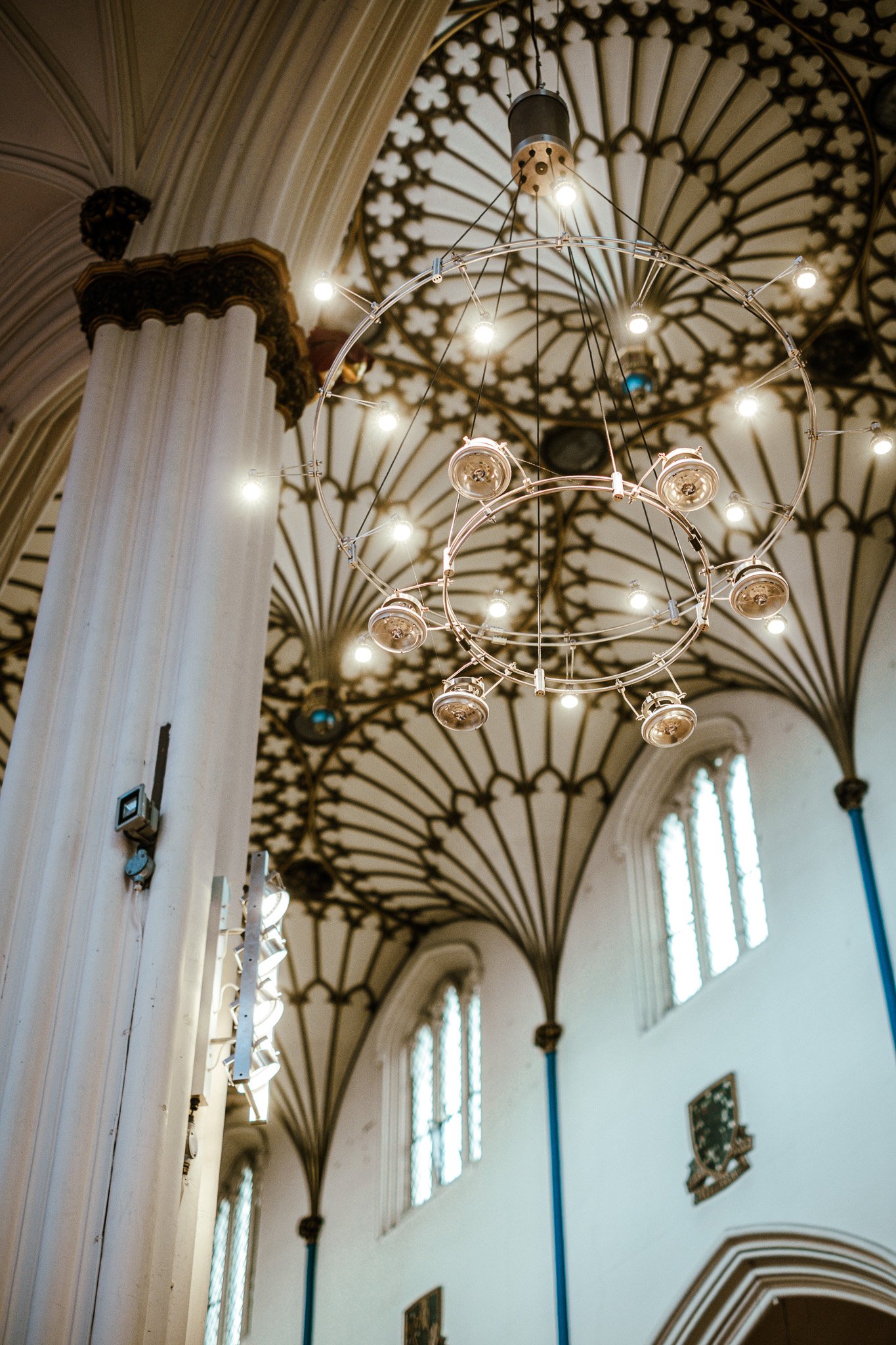
St John’s was built according to an English neo-Gothic (Perpendicular) design by the Scottish architect William Burn and despite setbacks, in particular a rather savage storm in January 1818 that destroyed the original steepletop, St John’s was consecrated on Maundy Thursday, 19 March 1818. The proprietors of Princes Street, already nervous at a crop of shops and warehouses popping up at the East End, obtained a private Act of Parliament in 1816 to stop any further building between the Mound and Lothian Road. This area now forms Princes Street Gardens. Daniel Sandford served as St John’s Incumbent until his death in 1830. Within St John’s, he established a tone of outgoing charity, devoted service and good relations with its Presbyterian neighbours which was to last into the future.
In 1827, he had appointed as his Curate Edward Bannerman Ramsay, who after the Bishop’s death succeeded him as Incumbent. He served for 42 years and played a key role in the revival of the Scottish Episcopal Church. He carried St John’s to new heights of popularity and prominence, and made a profound difference to its interior aesthetic. We see his legacy today in the memorials, windows and pews. He also injected energy into the whole area of mission, and St John’s was instrumental in setting up small churches and educational missions elsewhere in the city. The first initiative was a school and mission church in Tollcross in 1853, and others were to follow. Aware of the plight of less successful churches, Ramsay founded the Scottish Episcopal Church Society in 1838 to give financial help to poor clergy and congregations, and to support candidates for the ministry.
Ramsay was a dynamic and inspiring preacher and, as the congregation grew, the galleries had to be greatly extended to accommodate it, and extra chairs had often to be set out up the nave. He became a distinguished figure on the Edinburgh scene and within Scotland. He was appointed Dean of Edinburgh in 1846, and in time was to be offered two Bishoprics, both of which he turned down. In 1855 the church, known up till now as a ‘chapel’, finally became a ‘church’. When Ramsay died in 1872, around 20,000 citizens lined the streets at his funeral, and a copy of one of the old Celtic crosses on Iona was raised as his memorial on Princes Street. Inside St John’s, there is a monument of brass and stone designed by George Gilbert Scott, a marble bust, and a memorial window to his memory. In 1882, the church was further amended by the addition of a new chancel including a polygonal apse, executed according to a design by Peddie & Kinnear and replacing the original flat east-end of the church.
-
The 20th century saw further architectural developments, shaping the building into its current form. The choir stalls and oak panels of the chancel were added in 1910, based on the late-Gothic choir stalls at King’s College Chapel, Aberdeen. In 1912, a rood screen and cross were erected, separating the choir area from the nave. Only the cross now survives, while the rood screen was moved to the south east chapel of St Mary’s Episcopal Cathedral. Between 1914 and 1916, a vestry hall was also added to the south wall of the east burial ground, now part of the Cornerstone Centre. In-between the hall and the chancel, a chapel by W.J. Walker Todd was added in 1935. In 1937, the area underneath the nave and south aisle was excavated and subsequently turned into rooms and meeting spaces. During World War II, these rooms were used by service personnel as rest rooms. The vaults under the south terrace and Lothian Road were put to similar use: in 1939, they became public air shelters for the City of Edinburgh.
A series of gifted Rectors maintained the momentum Ramsay had originally created, and by 1960 the church had 1,200 communicant members. The 680 pew places were often full, when chairs had to be set out in the aisles. In the 1960s Rector Keith Arnold instituted Team Ministry and encouraged lay involvement, while his successor Aeneas Mackintosh had the rood screen dividing the chancel from the main body of the church removed. The church began to change from a very formal place with formal worship into one with a much more relaxed and spontaneous atmosphere.
This was also the time when St John’s began to work with other churches in the city centre (both Episcopalian and Church of Scotland) on a series of remarkable joint projects. This led to the inception of a Lunch Club, Cephas House (a supervised place where ‘lost’ young people could live), a Cellar with music for teenagers, a late-night Coffee House Mission, a drop-in for homeless people, and finally the Rock Trust for homeless teenagers, which is now independently run but extending its outreach well beyond Edinburgh.
The move for greater informality at St John’s was further encouraged by Neville Chamberlain (1982– 1997), who had a new wooden altar designed and brought much closer to the congregation. He also initiated the murals, prominently displayed outside the church to highlight current political issues.
-
His successor, John Armes, Rector from 1998-2012, led a compassionate and spiritual ministry before moving to become Bishop of Edinburgh. In 2001, the then Associate Rector John McLuckie discovered what turned out to be an Ethiopian Tabot – sacred artefacts within the Ethiopian Orthodox Church – in a cupboard at St John’s. The Tabot had been looted at the Battle of Magdala which concluded the 1868 British Expedition to Abyssinia by Captain William Arbuthnot of the 14th Hussars, who presented the object to St John’s. Given the sacred status and significance of the object, it was decided to return the Tabot into the hands of the Ethiopian Orthodox Church. In January 2002, it was handed back to an Ethiopian delegation during a six hour ceremony at St John’s.
John Armes was succeeded by Markus Dünzkofer. Markus, who had the difficult task of seeing the church through the pandemic and lockdown, stressed welcome and diversity, and conducted the first same-sex marriage ceremony in the UK, after the Scottish Episcopal Church had changed canon law in 2017 to allow for same-sex marriage. He began to reach out to a wider age range and oversaw the celebration of the church’s bicentenary and the redevelopment of the Hall and Lower Terrace. In 2018, the Cornerstone Centre opened its doors, providing a church hall for the congregation to gather, rentable event space, as well as new church offices. David Bagnall, the Rector of St John’s since 2025, has further built on this by holding a weekly gathering with Communion for young children and their parents (‘The Ark’), and opening the church (also weekly) to all-comers as a Welcome Space. Through all this, our tradition of preaching, prayer and the sacraments is given a high priority, implemented by our richly-talented ministry team.